My experience has taught me one thing: the technology is rarely the problem. That said, most organisations are sitting on fragmented, siloed data and wondering why their agents underdeliver. But the harder question we look at here is the human one. As platforms execute more of the work, what remains is irreducibly human. The judgment to know what matters. The wisdom to interpret what’s actually happening. The imagination to see what comes next. The courage to act when the answer isn’t certain.
What follows is a framework for doing exactly that. Building for AI agency, while ensuring the human remains not just in the loop, but the architect of the outcome. Here’s my work in progress framework for thinking about this.

Every enterprise right now is running two operating systems simultaneously. One built for human execution. One being built for autonomous execution. The friction between them is where most transformation programmes stall. And it is where the real work begins.
The old model measured who showed up. Login frequency, adoption rates, seats filled. Attendance was never the point.
The new model measures what changed. Decisions made faster. Cases resolved. Revenue generated. Performance, not presence.
The old model optimised the process. Define it, document it, train people to follow it, measure compliance.
The new model executes the process. What remains worth measuring is the outcome at the end of it.
The old model sold capacity. Headcount, licences, activity. Value scaled with what you put in.
The new model sells accountability for a result. The platform owns the execution. The human owns the outcome.
The driver of that shift is agentic AI. Systems that don’t wait for input. They execute work end to end, autonomously, and at a scale no headcount can match.
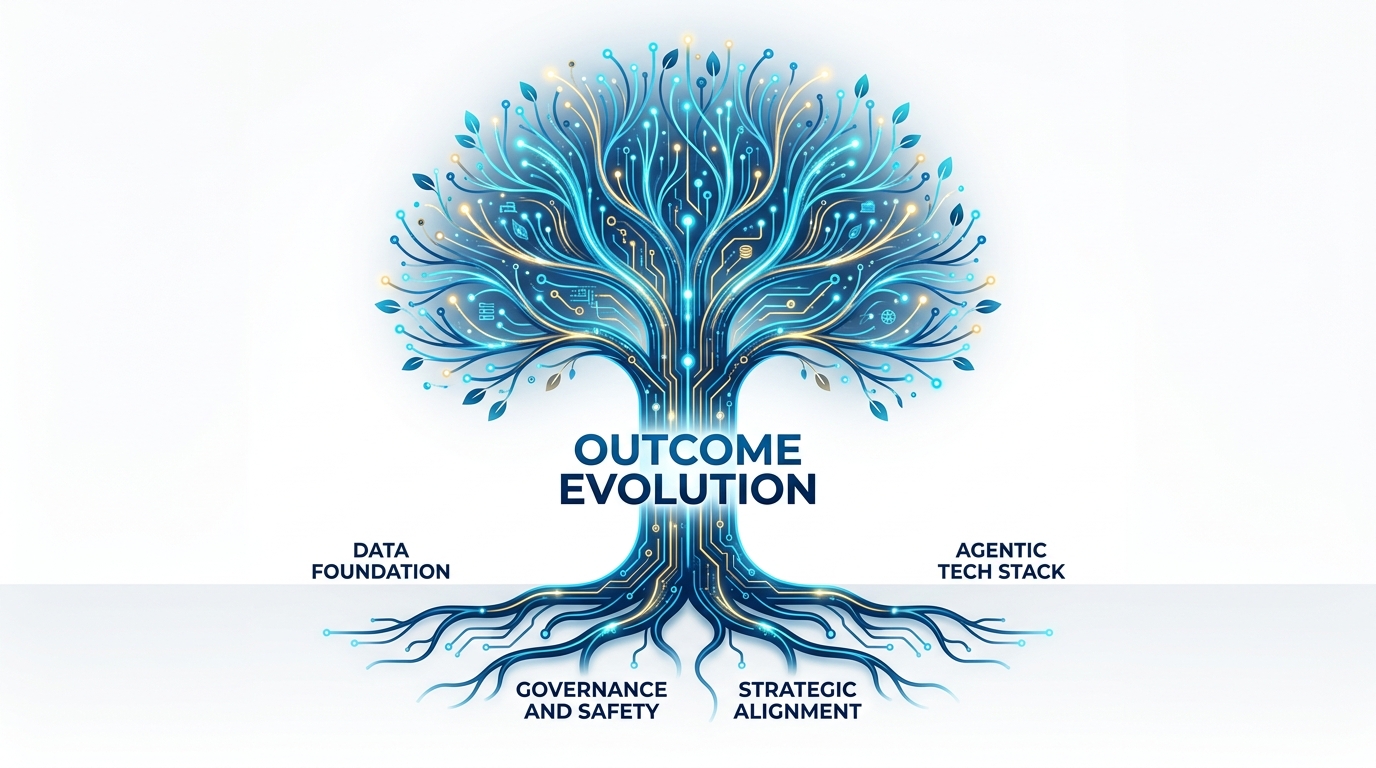
Most transformation programmes start at the top. A vision. A strategy. A set of outcomes someone has promised a board. Then they wonder why nothing grows. A tree doesn’t start with the canopy. It starts with the roots. Get the foundation right and growth follows. Skip it and everything above eventually fails.
Click any layer to explore the detail. The framework reads top to bottom as a dependency chain. But the real insight is this: most organisations invest in the top layers first, then wonder why their agentic capability underdelivers. It is not a technology problem. It is a foundation problem.
Strategy sits at the top — not as an output of the framework but as the context it operates within. Before any layer is built, there must be clarity on what problem is being solved and where the organisation is going. Every agentic investment that fails does so because this layer was either absent or ignored. The technology was not the problem.
When the agentic layer handles execution, humans move up to purpose. The job title stays the same. The work underneath it changes completely. Four enduring human capabilities that no agentic system replaces, not because the technology isn’t good enough, but because these are not execution problems.
Courage is deciding to act when the data doesn’t give you certainty. Wisdom is knowing which answer is right for this organisation, this moment, this context. Judgment is recognising what the model can’t see. Imagination is asking whether we’re solving the right problem in the first place.
This is the execution engine. Where the platform stops waiting and starts working. Automate, Augment, and Generate are the three active capability modes. Orchestrate and Govern underpin all three — they are the capabilities that make the stack safe, scalable, and trustworthy.
Most organisations invest in Automate and Generate first because they are the most visible. Both deliver early wins. But Orchestrate is where the compounding returns live — connecting agents, systems, and decisions across the enterprise in ways that no single capability can achieve alone.
Automate — Repeatable work that no longer needs a human in the loop. Augment — Human judgment made faster, better informed, more confident. Generate — Net new value that didn’t exist before. Orchestrate — Agents working across systems, functions, and decisions without being manually directed. Govern — Policy, accountability, and auditability built into the execution layer, not bolted on afterwards.
| Capability | Definition |
|---|---|
| Automate | Execution of defined, repeatable work without human involvement |
| Augment | Enhancing human judgment with agentic insight at speed and scale |
| Generate | Creating net new value — content, code, insight — that did not exist before |
| Orchestrate | Coordinating agents, data and humans across the enterprise |
| Govern | Policies and accountability that make autonomy trustworthy at enterprise scale |
The licence to operate autonomously. Not a constraint on transformation — the thing that makes transformation safe enough to scale. This is the layer most organisations underinvest in until something goes wrong, and by then the cost of retrofitting it is orders of magnitude higher than building it in from the start.
Compliance gravity is not a feature you can bolt on. It is accumulated over years of security vetting, audit trails, and policy architecture. Platforms that have it already are not just safer. They are strategically ahead. When your board, your regulator, or your customer asks how you know the agent did the right thing — this layer is the only honest answer.
| Component | Definition |
|---|---|
| Trust as a service | The proposition shifts from what software does to how much you trust it to act |
| Policy-based autonomy | Set the limit and the rules. Govern outcomes, not steps |
| Compliance gravity | Accumulated security vetting that compounds like data does — cannot be replicated overnight |
| Auditability | Every autonomous action must be explainable. If you cannot show the work, it did not happen |
The root system. Without it, agentic AI has nothing to act on. Data gravity is not just a metaphor — it is the single biggest competitive moat in the agentic era. Every agent, every autonomous workflow, every outcome delivered at scale draws from this layer. The quality of what lives here determines the quality of everything above it.
Organisations with unified, high-quality, structured enterprise data will compound their advantage over time. Organisations with fragmented, siloed data will pay an integration tax on every autonomous workflow they try to run. Agents don’t debate — they act on whatever they’re given. Which makes a single system of truth not a data architecture decision, but a strategic one.
| Component | Definition |
|---|---|
| Data gravity | Accumulated data creates strategic pull. Agents without it are clever toys |
| Unified platform | System of Record becomes System of Action. One source of truth for agents to act on |
| Integration discipline | Cut tools that create friction. If it is not part of a unified workflow, it is a liability |
| Outcome measurement | Stop counting seats and logins. Measure what the platform actually resolves |
The most common anxiety about agentic AI is that it eliminates human roles. The framework says the opposite: it elevates them. When the execution is handled, four capabilities that were always present but rarely prioritised move to the centre. These are not soft skills. They are the hardest things to do well — and not easily or safely automatable.
Going first. Holding purpose when the execution is messy and the outcome is still uncertain. Agents optimise toward probability. Courage moves toward possibility.
Lived experience that compounds with time. The longer you have accumulated it, the less replicable it becomes. A model trained on public data has knowledge. Wisdom requires the scars.
Seeing what should exist, not just what does. Setting the objective that agents then execute against. This is where strategy originates — not in the data, but in the mind that decides what to ask.
New frameworks need shared language. These are the terms that come up consistently in conversations about enterprise AI — defined precisely, without the marketing layer.